

A third DUI charge in Georgia is undeniably serious, but an accusation is not a final verdict. Regardless of your prior record, the burden of proof rests entirely on the prosecution to prove your guilt beyond a reasonable doubt.
To meet this high legal standard, the state must present an unbroken and convincing chain of evidence that establishes guilt beyond a reasonable doubt. Any gap, inconsistency, or weakness in that evidence can create reasonable doubt, forming the foundation of a strong legal defense and helping you pursue the best possible outcome: no conviction and no permanent record for a third DUI offense.
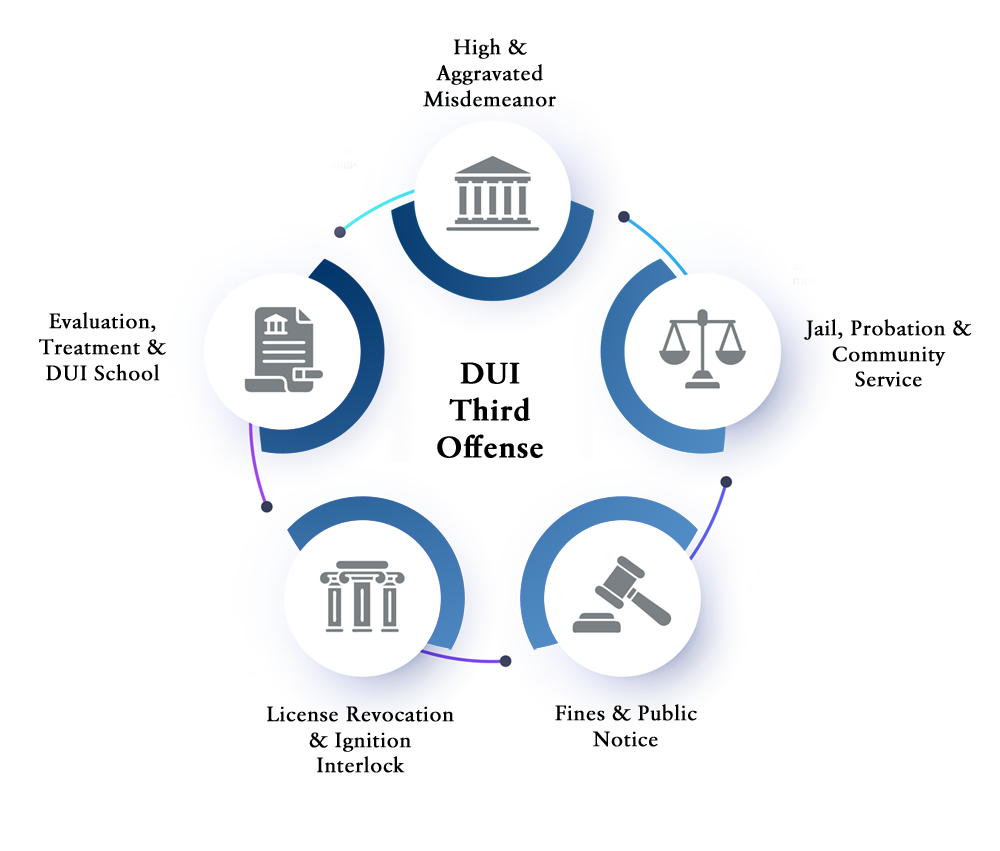
Third DUI Offense in Georgia
A third DUI offense in Georgia is treated far more seriously than a first or second offense. Under OCGA § 40-6-391, a third DUI within a ten-year lookback period is classified as a misdemeanor of a high and aggravated nature. While it is still a serious misdemeanor that is closer to a felony, it represents one of the most serious misdemeanor offenses under Georgia law and reflects the state’s view that repeat impaired driving poses a significant risk to public safety. Judges and prosecutors also often view a third DUI as a sign of an underlying alcohol or substance abuse problem rather than an isolated lapse in judgment.
A conviction for a third DUI carries severe and long-lasting consequences. In addition to a mandatory jail sentence, you face substantial fines, court costs, probation, mandatory community service, and publication of your photograph and conviction in your local newspaper at your own expense. The combination of these penalties can affect nearly every aspect of your personal and professional life.
The driver’s license consequences can be even more significant. If all three DUI convictions occur within a five-year period, Georgia law classifies you as a Habitual Violator. This results in a hard revocation of your driver’s license, and you are not eligible for a limited driving permit during the revocation period. Driving while your license is revoked because of Habitual Violator status is a felony offense that carries the possibility of a lengthy prison sentence.
A third DUI conviction also focuses on rehabilitation, not just punishment. The court will require you to complete a clinical evaluation to determine whether alcohol or drug treatment is necessary. You must also complete a DUI Risk Reduction Program and comply with any treatment recommendations. These requirements are intended to reduce the likelihood of future offenses while helping individuals address the issues that contributed to the DUI.
Two Ways Someone Can Be Charged with DUI in Georgia – DUI Per Se and DUI Less Safe
In Georgia, there are two most common ways the state can convict you of a third DUI: DUI per se and DUI less safe. DUI per se is based entirely on a breath or blood test result. If your alcohol level is 0.08 or higher, the law automatically considers you guilty, regardless of how well you were driving. The prosecutor does not have to prove you were stumbling or slurring your speech; they only have to prove that the official breath test machine’s number at the station was over the legal limit.
On the other hand, DUI less safe is a behavior-based charge. This is used if you refuse to take a breath test, if your alcohol level is actually below 0.08, or alongside a per se charge. In this situation, the prosecutor must prove that you were under the influence of alcohol or drugs to the point that it was less safe for you to drive than if you had not consumed them. To do this, they use the officer’s observations, such as swerving on the road, failing field sobriety tests, or having bloodshot eyes and slurred speech. Even without a chemical test, you can still be convicted based on the officer’s testimony about your physical state and driving.
When it comes to a third offense, it does not matter which type of DUI you are convicted of, since the penalties will be the same. Both can lead to a mandatory minimum of 15 days in jail, heavy fines, and a high and aggravated misdemeanor status. If you refuse the breath test to avoid a per se charge, you will likely still face a less safe charge. Essentially, Georgia law provides two different paths to ensure that repeat offenders cannot avoid a conviction simply by refusing the breath or by having a borderline alcohol level.
Actual Physical Control
The law doesn’t just forbid driving under the influence. It also forbids being in actual physical control of a vehicle. Meaning, if you are simply sitting in a stationary car sleeping it off without any evidence of prior movement, you can still be accused of DUI if the officer suspects you had been driving.
The court doesn’t offer a safety exception for pulling over for doing the right thing. If circumstantial evidence shows you operated the vehicle before putting the keys on the dashboard or turning off the ignition, the state can argue you were in physical control of the vehicle and still charge you.
Field Sobriety Tests
Field sobriety tests are physical and mental exercises done on the side of the road to help a police officer decide if there is enough evidence to arrest you. There are three main standardized tests: the Horizontal Gaze Nystagmus (HGN) test, where you follow a pen with your eyes, the Walk-and-Turn test, where you walk nine heel-to-toe steps on a line, and the One-Leg Stand test, where you balance on one foot while counting. These tests are designed to see if you can follow instructions while doing a physical task.
In reality, these tests can be difficult for anyone. Even sober people may have trouble, especially older adults or people with injuries, balance problems, or medical conditions. An officer uses your performance on these tests as part of the decision that you are less safe to drive than a sober person. It is also important to remember that the results are based largely on the officer’s observations and judgment.
Refusing Field Sobriety Tests
In Georgia, these roadside field sobriety tests are voluntary. You have the legal right to politely refuse them, and refusing does not automatically affect your driver’s license. For someone facing a third DUI, refusing these tests may prevent the creation of video evidence that could later be used in court.
Refusing the Breath Test
Refusing the official breath test at the police station carries far more severe administrative consequences than refusing the preliminary roadside breath test for a third offense DUI in Georgia. Under Georgia law, every driver is deemed to have given implied consent to state-administered chemical tests in exchange for the privilege of driving on public roads.
If you refuse this test or accumulate three DUI convictions within a five-year period, the Georgia Department of Driver Services (DDS) can suspend your license for five years or declare you a Habitual Violator. This triggers an automatic five-year revocation of your driver’s license. For the first two years of that revocation, you face a “hard suspension,” meaning you are completely ineligible for any type of limited driving permit—even for work, school, or medical appointments.
Lookback Period
The lookback period is the time frame the state uses to count your prior DUI convictions when determining your punishment. For a third DUI offense, Georgia uses two different lookback periods: one for your criminal penalties, such as jail and fines, and one for your driver’s license, such as how long you lose your right to drive.
The criminal lookback period is 10 years, measured from the date of your previous arrest to the date of your current arrest. If you have two prior convictions within those 10 years, your third offense is classified as a high and aggravated misdemeanor.
The lookback period for your driver’s license is 5 years. If all three arrests resulting in DUI convictions happened within the same 5-year window, you are declared a Habitual Violator. This triggers an automatic 5-year revocation of your license. During the first two years of this revocation, there is a hard suspension, meaning you are ineligible for any type of limited permit to drive to work or school.
If your three DUIs are spread out over 7 or 8 years, you will still face the heavy criminal penalties of a third DUI within 10 years, but you will avoid the Habitual Violator license revocation since the arrests did not all happen within a 5-year window.
Difference Between a Second and Third DUI Offense
Moving from a second to a third DUI in Georgia is a massive step up in severity because the state stops treating you as a typical offender and starts treating you as a habitual offender. On a second DUI, the charge remains a standard misdemeanor, though you still face mandatory penalty increases and strict administrative sanctions. Consider a driver who gets a second DUI: while they may have to serve a few days in jail and handle a temporary license suspension, they can usually secure a limited permit after a short waiting period, allowing them to keep their job and drive to the grocery store.
A third DUI changes everything by bumping the charge up to a high and aggravated misdemeanor. This status strips away judicial leniency, resulting in much longer mandatory jail time, steeper financial penalties, and lasting consequences that come with a severe criminal record. Take that same driver on a third offense: they now face Habitual Violator status with a mandatory “hard” license revocation, making everyday life almost impossible and turning the conviction into a life-altering event. Because the stakes are so high, most people accused of a third offense take the charge extremely seriously, aggressively fighting the case while proactively pursuing intervention and treatment.

Protect Your License from Suspension – Administrative License Suspension (ALS) Hearing
Many people think a DUI arrest automatically means they will lose their driver’s license. However, the license suspension can be challenged and, in some cases, prevented through an Administrative License Suspension (ALS) hearing.
An ALS hearing is an important part of a DUI defense. Because it is separate from the criminal court case, it gives your attorney an early chance to question the arresting officer under oath. This testimony may reveal mistakes or weaknesses in the state’s evidence that can help defend against the criminal DUI charge while protecting your driving privileges in the meantime.
After a DUI arrest, it is important to challenge the suspension. You must take action within a strict 30-day deadline from the date of your arrest. If you do nothing, your license will automatically be suspended. Many people wait until the last minute, but acting quickly is especially important for repeat offenses because of Georgia’s strict laws and sanctions for repeat offenders.
Filing an appeal within the 30-day deadline gives your attorney time to conduct a preliminary investigation into the facts of your case. The ALS hearing focuses on whether the officer followed the proper legal procedures, such as whether the traffic stop was lawful and whether the implied consent notice and chemical testing requirements were handled correctly. Taking action within those first 30 days is essential to protecting your right to drive and preserving critical evidence that can potentially help resolve your case with a favorable outcome.
Sentencing
Under Georgia law, sentencing for a third DUI offense within a 10-year period is governed by the state’s high and aggravated misdemeanor laws (O.C.G.A. § 40-6-391). This classification limits judicial flexibility and imposes stricter rules governing actual time served than those for a first or second offense. The law requires a total sentence of 120 days to 12 months. While a judge can allow part of this sentence to be served on probation, they are legally required to order a minimum of 15 days of actual incarceration that cannot be suspended or stayed. Mandatory penalties also include a fine between $1,000.00 and $5,000.00 (plus court surcharges) and at least 240 hours of community service.
The “high and aggravated” status specifically restricts good-time or earned-time credit under O.C.G.A. § 17-10-4. While a standard misdemeanor inmate might serve only half of their sentence, high and aggravated credit is capped at a maximum of 4 days per month, meaning most of the court-ordered jail time must be served. Third-time offenders serve this time in a county jail rather than a state prison. However, if a third DUI occurs within a 5-year window—rather than 10 years—it triggers Habitual Violator (HV) status under O.C.G.A. § 40-5-58. Driving during a 5-year HV revocation is a separate felony punishable by 1 to 5 years in state prison.
Aggravating Factors
Under Georgia law, aggravating factors are specific conditions surrounding a DUI arrest that increase the severity of the charges or lead to harsher penalties. A third DUI within a 10-year period is already classified as a misdemeanor of a high and aggravated nature. However, certain aggravating circumstances, such as carrying child passengers, causing serious injuries or fatalities, having a high blood alcohol concentration (BAC), or driving with a suspended license, can make the legal consequences even more severe by increasing the charges or leading to the maximum penalties allowed by law.
Under O.C.G.A. § 40-6-391(l), having a passenger under the age of 14 creates a separate Child Endangerment DUI charge for each child in the vehicle with serious potential jail time.
Other aggravating circumstances can raise the case to a felony or result in the maximum penalties. If the DUI causes a crash that results in serious bodily injury, such as broken bones, loss of a limb, brain damage, or serious disfigurement, the driver may also be charged with Serious Injury by Vehicle under O.C.G.A. § 40-6-394. This felony carries a prison sentence of 1 to 15 years for each injured victim. If the crash causes a death, the driver may be charged with First-Degree Vehicular Homicide under O.C.G.A. § 40-6-393(a), which carries 3 to 15 years in prison, or 5 to 20 years if the driver was operating a vehicle while under an active Habitual Violator license revocation. In addition, a BAC of 0.15 or higher or driving with a suspended license does not change the DUI charge itself, but it can trigger mandatory conditions, such as an ignition interlock device, and often leads judges to impose the maximum penalties allowed by law for each count. These aggravating factors show how a single third DUI can quickly result in multiple criminal charges or escalate into a serious felony case, depending on the circumstances of the arrest.
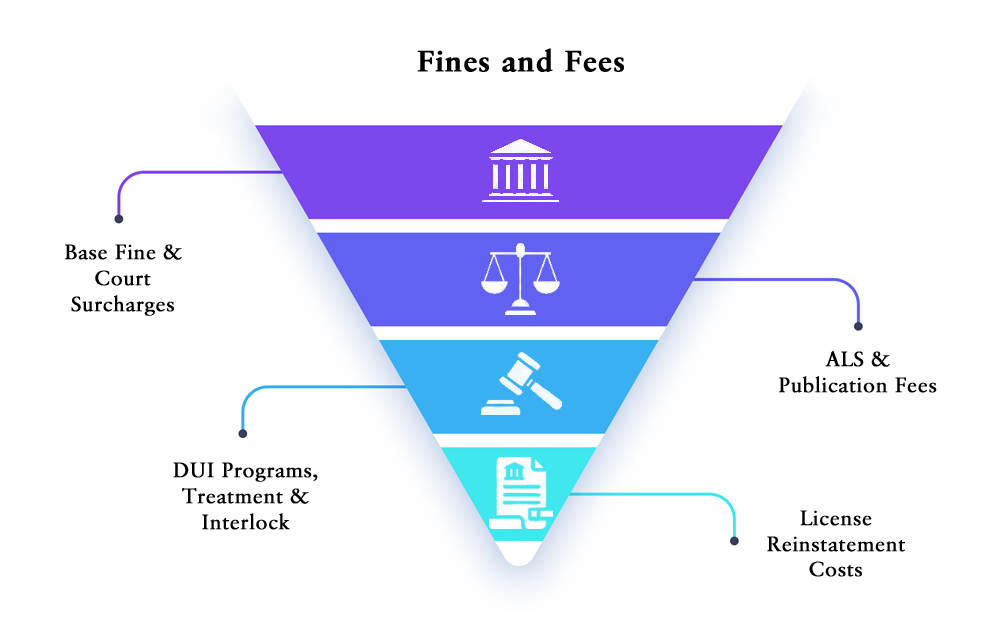
Fines and Fees
The financial cost of a third DUI in Georgia is designed to be punitive and routinely reaches well into the thousands of dollars. The core of these costs is the base fine, which is statutorily set between $1,000.00 and $5,000.00 under O.C.G.A. § 40-6-391(c)(3). Because a third offense within a 10-year lookback period is classified as a misdemeanor of a high and aggravated nature, judges cannot suspend, stay, or probate the minimum $1,000.00 fine.
However, the base fine is only the starting point. Georgia applies mandatory statutory surcharges to court fines—including additions for the Peace Officers’ Annuity and Benefit Fund, Jail Construction and Staff Training Fund, Drug Abuse Treatment and Education Fund, Crime Victims Emergency Fund, Brain and Spinal Injury Trust Fund, and Driver Education Fund—which can add 40% to 50% or more to your base fine. This means a $1,000.00 base fine typically results in a total court payment of roughly $1,400.00 to $1,500.00 or more.
Beyond the courtroom, several administrative fees are required by law. If you choose to challenge your Administrative License Suspension, you must submit a $150.00 filing fee to the Georgia Department of Driver Services within 30 calendar days of your arrest. You are also responsible for the mandatory $25.00 publication fee under O.C.G.A. § 40-6-391(j) to have your name, photo, and address published in the local county legal organ newspaper.
If you are convicted of a third DUI within five years, you are declared a Habitual Violator, resulting in a mandatory five-year license revocation. If you apply for a Habitual Violator probationary license after serving two years of the revocation, the statutory fee is $210.00, or $200.00 if paid by mail. Full driver’s license reinstatement at the end of the five-year revocation carries a statutory fee of $410.00, or $400.00 if paid by mail under O.C.G.A. § 40-5-62.
There are also required out-of-pocket program costs. State law mandates a fixed fee of $360.00 for the DUI Risk Reduction Course, which includes a $100.00 assessment fee, a $235.00 course fee, and a $25.00 workbook fee. A mandatory clinical substance abuse evaluation typically costs between $100.00 and $150.00, and if clinical treatment is recommended, those sessions can cost $1,000.00 to $3,000.00 or more over several months. Additionally, driving privileges following a third DUI require an ignition interlock device to be installed in your vehicle, carrying an installation fee of $75.00 to $150.00 and a monthly lease fee of $70.00 to $100.00.
When you total the base fine, mandatory state surcharges, legal organ publication fee, administrative hearing fees, reinstatement costs, and required program expenses, the baseline out-of-pocket cost for a third DUI in Georgia routinely ranges from $5,000.00 to $7,000.00, even before factoring in defense attorney fees or high-risk insurance rates.
FAQs
Will I definitely have to go to jail for a third DUI?
No, jail time is not guaranteed simply because you are charged. However, if you are convicted of a third DUI within a ten-year lookback period (measured from arrest date to arrest date), Georgia law (O.C.G.A. § 40-6-391) mandates a minimum of 15 days of actual incarceration, which a judge cannot suspend, probate, or stay.
How can I drive legally while a 3rd offense DUI is pending in Georgia?
You generally cannot get a probationary license or an ignition interlock permit for a pending third DUI if you have a prior DUI conviction within the last five years under O.C.G.A. § 40-5-64.1. One common option is to have your attorney file an Administrative License Suspension (ALS) appeal with the Georgia Department of Driver Services within 30 days of your arrest. If the appeal is filed on time, it may extend your driving privileges while you wait for your administrative hearing, allowing you to continue driving legally. If your attorney wins the ALS hearing, you can regain your driving privileges.
Can a third DUI be reduced or dismissed in Georgia?
Yes. Every case has potential weaknesses, and thorough preparation and evidence collection can make all the difference. For example, a defense attorney may challenge the legality of the traffic stop, the arrest, the accuracy of breath or blood tests, or whether the officer followed proper procedures. In some cases, completing alcohol or drug treatment and identifying weaknesses in the state’s evidence may help negotiate a reduced charge or achieve a more favorable outcome.
Do I really have to put my picture in the newspaper?
Yes, under Georgia law, you are required to pay a fee to have your name, address, and photo published in your local county newspaper after a third conviction.
Do out-of-state DUIs count as prior offenses in Georgia, and how are lookback periods and case dispositions evaluated?
Out-of-state DUIs can count as prior offenses in Georgia if the other state’s DUI law is substantially similar to Georgia law for driver’s license and Habitual Violator purposes. Georgia uses a 10-year lookback period, measured from arrest to arrest, for criminal sentencing enhancements. The Georgia Department of Driver Services (DDS) uses a 5-year lookback period, also measured from arrest to arrest, for driver’s license suspensions and Habitual Violator (HV) status.
The final disposition of the case is also important. DUI convictions and nolo contendere (no contest) pleas generally count as prior offenses. However, reduced charges, such as reckless driving, dismissals, and acquittals, generally do not count as prior DUI convictions. Out-of-state diversion or deferred adjudication programs must be evaluated on a case-by-case basis. If the court required a guilty plea or finding of guilt that was reported through interstate databases, Georgia courts or the DDS may still treat the case as a prior DUI conviction.
License Revocation and Suspension
The difference between a license suspension and a revocation for a third DUI depends on how close together your arrests were. If you have three DUI convictions within a five-year period, the state officially labels you a Habitual Violator, which triggers a five-year revocation of your driving privileges. This is much more severe than a standard suspension because it completely cancels your right to drive. For the first two years of this five-year period, you face a hard suspension, meaning there are absolutely no exceptions, including a limited permit to drive to work, school, or the doctor. You are legally barred from being behind the wheel for 24 months.
After you have completed those first two years of the hard suspension, you may be eligible to apply for a probationary license. To get this restricted permit, you must prove that not being able to drive causes an extreme hardship, complete a DUI risk reduction course, and finish any clinical substance abuse treatment required by an evaluator. Even if granted, this permit only allows you to drive to very specific, pre-approved locations (home, work, etc.). If you are caught driving for a third time while your license is revoked under the Habitual Violator status, it becomes a felony offense that can result in one to five years in state prison.
Ignition Interlock Device
An ignition interlock device, or an IID, acts as a car breath test, preventing your vehicle from starting if it detects alcohol. For a third DUI conviction within five years, you are typically declared a Habitual Violator, which makes the rules for getting an IID much stricter than they are for first or second offenses. You cannot even apply for a permit to use this device until you have completed a mandatory two-year hard suspension during which you are not allowed to drive at all. Once that period is over, you may be granted a probationary license on the condition that you install an IID in every vehicle you own or operate for at least one year.
The device is not a one-time setup. It requires you to blow into a mouthpiece every time you want to start the engine, and it will also prompt you for rolling retests while you are driving to ensure you haven’t started drinking after the car was already running. Additionally, you must take the car to a service center every 30 days to have the data downloaded and sent to the Department of Driver Services. If the device logs a failure or if you attempt to tamper with it, you face a misdemeanor charge, potential jail time, and the immediate loss of your limited driving permit.
Mandatory Alcohol and Other Drug Assessments
Completing both a DUI risk reduction program and a clinical evaluation is a mandatory requirement for a third DUI conviction. The risk reduction program, often called DUI School, is a 20-hour group class focused on educating you about the dangers of impaired driving. Before the class begins, you must take a 130-question screening to assess your substance use history. You must complete this course in person at a school certified by the Department of Driver Services.
Separate from the classroom course, you must also undergo a one-on-one clinical evaluation with a licensed professional certified by the state. This is a private diagnostic interview where a counselor determines if you have a clinical dependency on drugs or alcohol. Because the state views a third DUI as a sign of a serious problem, the evaluator will almost certainly recommend a treatment program, which usually lasts for at least 17 weeks and must be paid for out of pocket.
Community Service
Community service is a strictly mandatory part of sentencing for a third DUI offense within a 10-year period. The judge is required to order at least 30 days of community service. In the Georgia court system, a day of community service is calculated as 8 hours, meaning you must complete a total of 240 hours. Because a third DUI is classified as a high and aggravated misdemeanor, these hours are almost never reduced or bought out with a fine. Instead, you must physically perform the work at a registered 501(c)(3) non-profit organization or a government agency.
The court typically sets a strict deadline for completing these 240 hours, usually within the first 6 to 9 months of your 12-month probation period. You are responsible for finding an approved location, such as a food bank, animal shelter, or roadside cleanup program, and you must notify the organization that your service is court-ordered for a DUI. It is critical to keep a detailed log of your hours, signed by a supervisor on the organization’s letterhead, as your probation officer will require this proof. Failure to complete the full 240 hours by the court’s deadline is considered a probation violation, which can lead to a judge revoking your probation and sending you back to jail to serve the remainder of your sentence.
Victim Impact Panel
A Victim Impact Panel (VIP) is an educational session where attendees listen to first-hand accounts from individuals whose A Victim Impact Panel (VIP) is an educational session where attendees listen to first-hand accounts from individuals whose lives have been permanently altered by impaired driving crashes. While judges may order a panel for a DUI conviction, it is a common condition of probation or pretrial diversion across many jurisdictions, whether for a first offense or repeat offenses.
These sessions are typically hosted by non-profit organizations such as Mothers Against Drunk Driving (MADD) or local court-approved providers. They are designed to demonstrate the real-world human toll of driving under the influence, moving beyond legal fines and statutory penalties to focus on empathy and accountability.
Upon completing the session, attendees receive an official certificate of completion to submit to their probation officer or the court as proof of compliance.
Because these panels are typically court-ordered, administrative rules are strictly enforced:
- Punctuality: Attendees must arrive early. Doors are locked precisely at the scheduled start time, and late arrivals are barred from entry.
- Sobriety: Attendees must remain completely sober. Many in-person panels utilize visual screening, behavioral monitoring, or breath test checks prior to entry.
Attempting to enter while under the influence or arriving after the doors close will result in immediate denial of entry. Failure to complete a court-ordered panel is reported to the court or probation department as a probation violation, which can lead to severe consequences, including driver’s license sanctions or jail time.
A Victim Impact Panel is typically a single session lasting roughly one to two hours, intended to reinforce the gravity of impaired driving and prevent future offenses.
Early Intervention for Third Offense DUI Charges
Early intervention refers to taking proactive, voluntary steps to address a third DUI arrest before you ever step into a courtroom. By taking early steps to fulfill requirements that are commonly ordered by the court, such as completing a DUI Risk Reduction Program and undergoing a clinical evaluation, you provide your attorney with powerful evidence to show the prosecutor and judge that you are taking accountability. For many third-time offenders, the evaluation recommends a treatment program. Starting treatment immediately after your arrest, rather than waiting for a judge’s order, demonstrates a genuine commitment to change and can strengthen your position during negotiations and sentencing.
Beyond the classroom and counseling, early intervention also includes getting a head start on community service and attending a victim impact panel. Judges and prosecutors often look for signs of remorse, responsibility, and proactive change. Arriving in court having already taken meaningful steps toward rehabilitation demonstrates that you are serious about addressing the issues that led to your arrest. These efforts can also make it easier to stay on track with any requirements the court may ultimately impose.
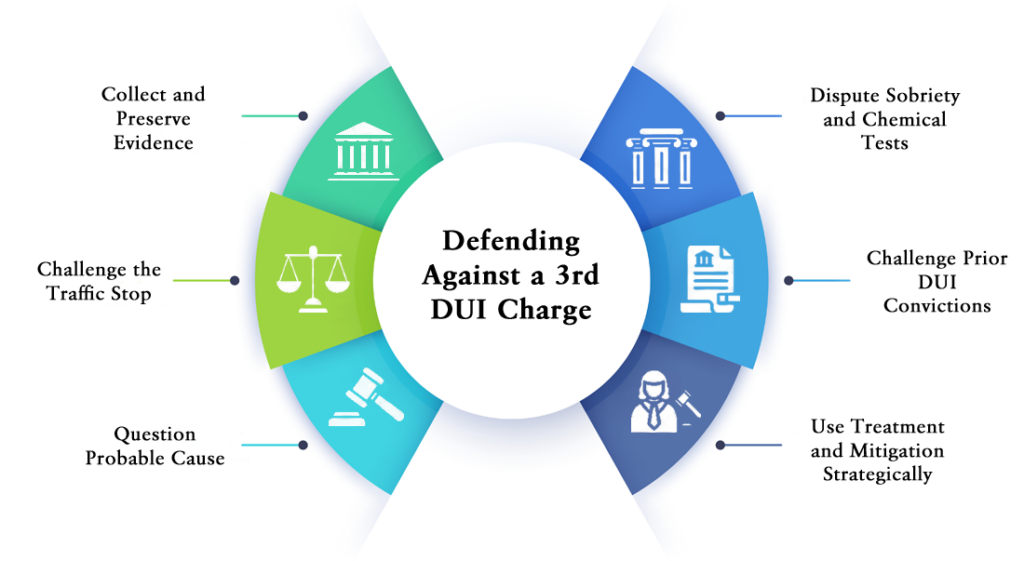
Challenging a 3rd Offense DUI
Preparation is what wins cases. If the defense knows more about the case than the prosecution and the arresting officer, the chances of success increase significantly. That process begins with collecting the evidence needed to support the defense. Once the evidence has been gathered, a defense strategy can be developed.
Every third DUI case should be carefully examined for weaknesses in the state’s evidence. A strong defense often begins by challenging the legality of the traffic stop, whether the officer had probable cause to make the arrest, the administration and interpretation of field sobriety tests, and the accuracy and reliability of breath or blood test results. A defense attorney may also seek to suppress evidence that was obtained unlawfully or argue that law enforcement failed to follow required legal procedures.
Beyond challenging the evidence in the current case, the defense may also focus on whether prior DUI convictions can legally be used to enhance the charge or sentence. For example, if prior convictions fall outside the state’s statutory look-back period, an attorney may argue that the current offense should not be treated as a repeat offense for sentencing purposes.
In some cases, addiction may be a contributing factor that should be addressed as part of the defense strategy. Demonstrating that addiction played a role in the arrest and that the defendant has proactively entered alcohol or drug treatment may help support negotiations for reduced charges, alternative sentencing, or another more favorable resolution.
No two cases are alike, and the most effective defense strategy depends on the specific facts, evidence, and circumstances involved. Thorough preparation, a comprehensive investigation, and a well-developed legal strategy provide the best opportunity for a favorable outcome.
Schedule a Free Case Evaluation
If you have been charged with a third DUI in Georgia, the decisions you make now can have a significant impact on your future. Zeliff | Watson offers free, no-obligation case evaluations, giving you the opportunity to speak with an experienced DUI defense attorney, understand the charges you are facing, and learn about your legal options before making any decisions.
Over the years, Zeliff | Watson has successfully defended many third DUI cases that initially appeared unwinnable. The firm’s defense team knows how to uncover weaknesses in the prosecution’s case, challenge the evidence, and build the strongest defense possible.
The consultation typically lasts an hour or longer and is protected by attorney-client privilege. During the consultation, the defense team will review the facts of the arrest, begin collecting evidence, answer your questions, and explain what to expect throughout the legal process.
Following the consultation, the defense team will begin investigating the case, identifying weaknesses in the state’s evidence, and developing a defense strategy tailored to your circumstances. A clear quote for legal services will also be provided.
The consultation is completely free, and there is no obligation to hire the firm. It is simply an opportunity to understand your legal options, begin building a strong defense, and help you realize options you may not have considered that could help you sleep better tonight. Taking action is the first step toward a resolution.
A Simple Process to Getting Started

Schedule a Free Case Evaluation
Schedule a free, no-obligation, and confidential case consultation in person, online, or over the phone. This will help you understand how your case can be challenged, potentially leading to a reduction, dismissal, or acquittal of your charges. Click here to schedule your case evaluation.

Meet Our Defense Team and Conduct a Case Evaluation
During your free case evaluation, you’ll have the opportunity to ask questions, receive answers and legal guidance, and collaborate with our attorneys to better understand your side of the story, gather evidence, and devise a strategy to achieve the best possible outcome for your pending criminal charges.

Start Defending Your Case
After your free case evaluation, Zeliff & Watson will assist in preserving evidence and safeguarding your rights, ensuring your protection throughout the process. The defense team will also provide a proposed fee to represent your case, with the goal of achieving the best possible outcome.